Wednesday, 22 September 2010

Day 1 Lavelanet to Ste Colombe sur L'Hers (8.29 miles.)

When we picked it as base we knew nothing about Lavelanet It was simply central and on some major footpaths.
We found it’s not a particularly beautiful town but seems like a good place to live with lots of things going on , some good shops and what seems to be a lot of communal/regional investment. We noticed two sports stadiums, a little theatre, a gym, outdoor pool, even the judo club had dedicated premises. The municipal campsite had a really good new, clean sanitation block, absolutely vital for making camping a reasonable experience. The site was managed by a very helpful lady who agreed that we could leave our car inside the site for the week.
The town used to be a centre of the textile industry. It grew up alongside a fast river. In early times the water was important for washing and dyeing the fabrics; later the water was used to power the looms. Many of the old factory buildings still exist and when we peered through the windows of one near to the textile museum we realised that it was still equipped (or reequipped for display?) with looms.


We slept the night in the ‘monstrosity’ , a tent that gives us loads of space but offends my artistic sensibilities , tents should be nice quiet colours not loud orange and reds. Unfortunately neither of us had a good night as we both felt a bit cold.
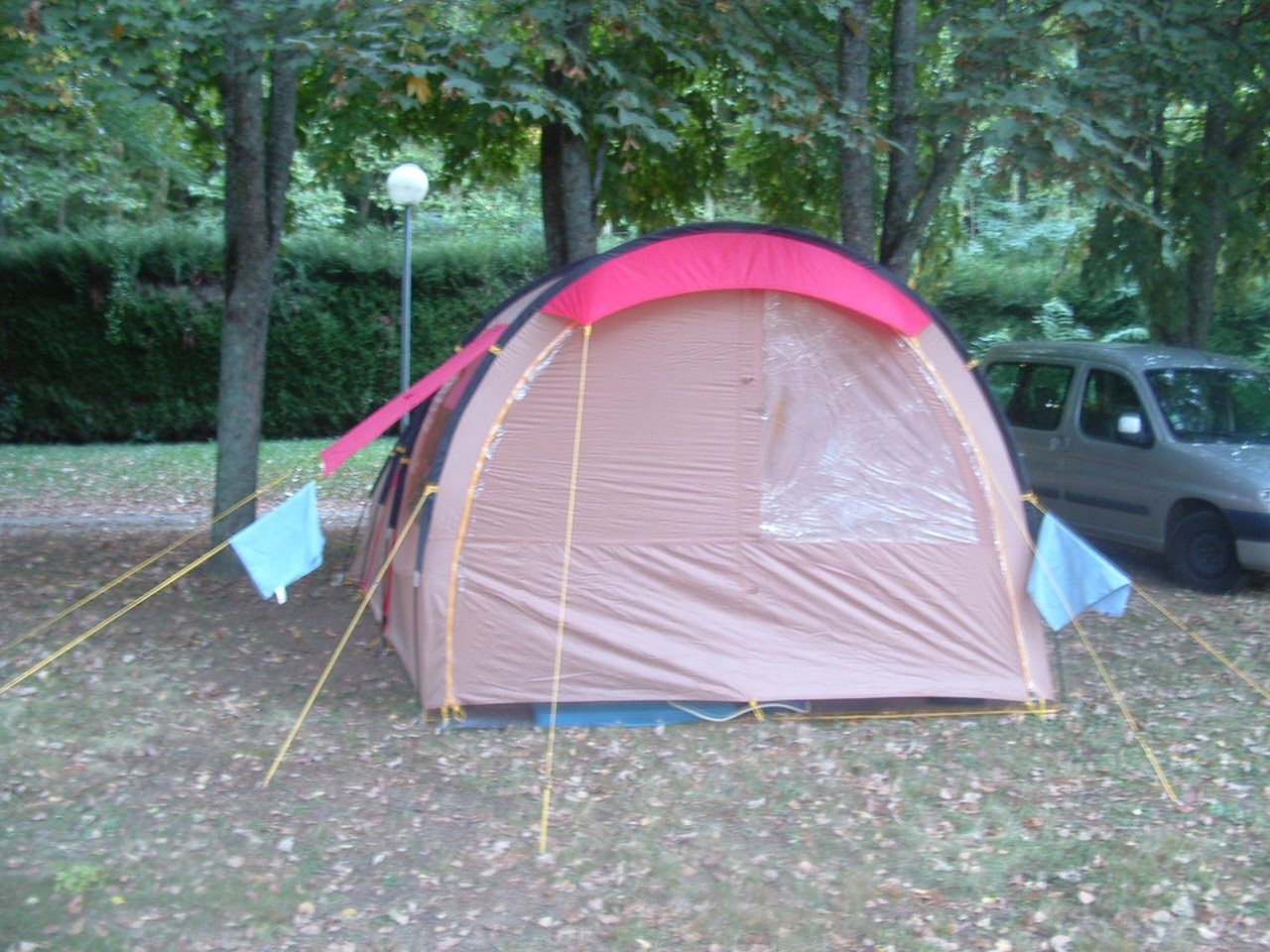


It took us forever to pack up the tent, pack and repack rucksacks trying to make sure we didn’t leave anything behind and then get going. It was 11.20am by the time we walked out of the campsite. As soon as I was out of the gate I realised I hadn’t checked glucose level, stop take off backpack; check. ...11.4mmol. I’ve no idea where that came from but decided not to correct Because it was so late we decide to stop for a coffee when we got into town but on arrival the cafe is shut with a , notice on the door ‘en greve’ .(.on strike), momentary panic...what if we get to our first stop and everywhere is shut because of the strike, will we get anything to eat? A quick look around reassures us as the cafe is the only business closed. About 20min later we find an open cafe (Lavelanet is a long town) and check glucose level which had descended to a more reasonable 7.4mmol. In fact at this point I lower my basal rate on the pump to 50%.
Restored (we’d done less than 2 miles!) we shouldered our packs and found our way out of Lavelanet onto the Voie Vert; an old railway track.


We were sensible to choose this route for day 1. It was a fairly easy, flat walk but with a backpack it took us far longer than it would do normally.


We went through a number of small towns once industrially important, now merely sleepy. It astounded me to learn that one industry horn working was big enough to necessitate the importation of horns all the way from New Zealand. I was a bit nervous as we approached a long tunnel, but I had no need to be,it contained movement activated lighting!


By lunchtime I knew that exercise was working it's magic on the glucose levels and I was in the high 3s by the time we sat down on the grass to eat. I cut the insulin for lunch in half and reduced the basal to 20% (0.1unit per hour). Even so I was sub 4 later and needed to stop for a snack before we got to our days campsite.
The site, just next to the track was basic but that didn't matter, we had it to ourselves. We set up camp and went out in search of food. First we found a little shop and checked they would be open the next morning so no worries about picnic for the next day.


We found a very unassuming looking restaurant and booked a table, then back to the site to rest a bit.

The restaurant was a brilliant surprise, A la Bonne Table was a cafe at the front , but at the back, a huge dining room. Since there were no windows the room was dark but was heated by a huge open fire (rather incongrous after the hot day) Later on we noticed it was used to grill steaks.
The meal was fantastic value for money. The portions were generous and everything was beautifully presented. To start a salad with lardons , this was big enough for a main course on it's own, a mixture of leaves topped with a mountain of crisply cooked lardons. To follow I had trout. It came scattered with almonds and accompanied by mussels, prawns and a creamy sauce...with a large number of slightly spicy baked potatoes (sans skin)...my glucose levels were good and I knew I had no fears about the amount of carbs but I couldn't manage all of them. After that a local sheeps cheese and to finish a thin slice of 'Opera', a gateau filled with a chocolate mousse.
A brisk walk home and to bed in our lightweight tent. A structure altogether more tasteful than the monstrosity


and whether it was the food and wine, or the temperature both of us felt very much warmer than the night before. Glucose level was 5.9 mmol, just a little worried that it might be too low.

Friday, 10 September 2010

Hi Ho, Hi Ho, It's Off To Walk We Go.

All packed including the kitchen sink.

This is my first multi day walk since the pump, hopefully fewer hypos than last time on MDI. Being able to reduce background insulin is my main reason for having it.

And meanwhile, here is one of the ups on our journey.

Montségur *this photo was taken by User:Gerbil from de.Wikipedia in August 2006 Category:Montségur)

Tuesday, 7 September 2010

Kit list

Ok, this is what I've worked out so far. I've also got a second list of things that can go in the car for a more relaxed camp in week 2. I find it very difficult not to try to cover every possibility so I end up with far too much so this maybe more than we take....although I still might think of some essentials we can't leave behind!

Proposed Personal Kit
(until I weigh it and

decide what I don't really need)
Walking poles ***********************Rucksac 50 litre
Sleeping bag ultralite**sleeping mat****Silk sheet sleeping bag
Survival blanket*********************1.5 litre water bottle
Lightweight towel********************Toothbrush/flannel etc
Pants 5***************************** Bras 3
Pyjama top and shorts*************** 3 pairs walking socks, 2pairs ordinary socks
1 pair shorts*************************1 pair convertible shorts/trousers
3 breathable t shirts***************** 1 smarter blouse + 1 t shirt
1 lightweight zipped fleece*************Waterproof Poncho
Sandals ****************Walking boots *********** hat
Camping spoon/knife/forkPlate/cup
Book to read/pen/notebook************ Medical alert bracelet

Diabetes Supplies
Frio ; 1.5 vials insulin; 3 reservoirs; 4 infusion sets; 4 vials chlorehexidine;4 pkts gauze squares ; 2 spare batteries; Meter with new battery ; 3 tubs strips;
3 packets dextrose Small plastic bottle for sharps lancets
In case of pump problem emergency telephone number
Pump failure kit needles ; 2 apidra pens; 2 novorapid pens

And these things have to be divided between OH and I.

Tent Mckinley moonlight 3.2 kg************* Campin Gaz 206 stove with bottle
2 person cook set *************************Wooden spoon/spatula
Plastic egg cups ***************************Egg container with 6 eggs
Tiny salt pepper **************************Small bags with spices/herbs
Dehydrated curry for emergency ***********350g packet wholemeal wraps(If we can't get bread)
Teabags,coffee sachets, sweetner ************100g Dried milk in ziplock
50g Choc drink powder in ziplock************ 200g Muesli in ziplock
200g wholemeal pasta *********************Packet parmesan
Cereal barres ***************************** Matches/lighter
In small plastic bottles, cooking oil, washing up liquid, clothes washing liquid, tiny pegs
Shampoo/shower gel. toothpaste Small tube sunscreen Loo paper
Small first aid kit/ibuprofen/immodium/blister plasters
Camera Spare xd card ; Garmin fore runner and charger; Mobile phone and charger;
Swiss army knife; pan scourer
Maps : 1:25 2247 OT Lavelanet Montsegur 2147 ET Foix

Books: Le Sentier Cathare Barthes ; The Cathar Way Mattingly
Compass/whistle ; Bank cards ; Cash ; Carte vitales./prescription

Oh last but not least a portable, foldable kitchen sink!


More ups and Downs

I'm back, to blog some more ups and downs.

This time not glucose levels, but I'm sure that will come into it. We're off on Friday for a long walk in the Pyrenees . We're doing seven days inclding part of the Sentier des Cathares and then we'll stay at a campsite and do some day walks to some of the other Cathare Castles. We had intended to walk the whole Cathare way but after looking at the logistics found that it would cost far more than we would afford so this is our compromise.


We will drive to Lavelanet on Friday . Next morning is quite a gentle start following the Voie Vert, an old railway now converted to a footpath to Ste Columbe sur L'Hers . Next day we walk to Puivert where we join the Sentier des Cathares walking to Espezel, Comus, Monsegur and Roquefixade. The last stage of our walk will take us back to Lavelanet. Some nights we are camping, others staying in gites d'etape (bit like a youth hostel). We've tried to plan quite carefully as some places are miles from the nearest shop or restaurant. We need to make sure that we can get the ingredients for each meal.(and not have to carry too much).


The map shows an aproximate route, and isn't actually that far at about 75 milesbut I think there are some wiggles missing. I hope to use the garmin I use for running to get an accurate trace of each days stage

The elevation profile shows why daily distances are relatively short. According to Mapmywalk there is one HC climb (the hardest) and 1 Cat 1, 2 cat 2, 1 cat 3, 3 cat 4 and 5 cat 5 climbs on the route but as I put the route in fairly roughly it might be very inaccurate, we shall see.


Sunday, 6 December 2009

Whole Blood or Plasma?

Mary, Mary quite contrary
How does your meter read?
With millimoles ,
Or milligrams
And clinical accuracy?

Mary Mary quite contrary
What does you meter mean?
Glucose in blood whole?
Or from the plasma sole
It's average your A1c?
With Apologies to Northerner: imitation is the sincerest form of flattery! (I don’t think it scans as well as your poems)

Any PWD on the internet soon realises that different parts of the world use different measurements for blood glucose readings. In the US, some parts of Europe and the Middle East they use milligrams per decilitre. In the UK , some parts of Europe and many places that are English speaking (Canada, Australia etc) they use millilmole per litre. To be awkward in France they use grams per litre.
It’s easy to change between the two, there are many convertors on the web but all you have to do to convert mmol to mg/dl is to multiply by 18, if you want to convert mg/dl to mmol/l you divide by 18. After a while you become bilingual.


But there is another difference that isn’t so obvious. When we measure our glucose we use whole blood from a capilliary. When a laboratory measures blood they measure the levels in the plasma.
For many years all the blood glucose meters reported the glucose level as in whole blood but this was not the same as a laboratory measurement would be. A laboratory plasma measurement would be about 12% higher than a whole blood one. In recent years some manufacturers have included a calculation (done automatically) that works out what the plasma reading would be and displays that as its reading.


Imagine you have 2 meters, both perfectly accurate (of that later) one whole blood, one plasma calibrated. You do a test with same spot of blood.
If it were plasma calibrated and it read 72mg/dl, the whole blood meter would read 64.3mg/dl.
So what constitutes a hypo depends upon what meter you are using
.


When people in different countries are writing about their levels, they may not be using meters calibrated in the same way.It is important to know what type of meter you have because some blood glucose targets are written to reflect whole blood readings whilst others are written for plasma, if you are reading targets written for whole blood, they may be too low for people using plasma calibrated meters.

In the US all modern meters give plasma readings but in Europe some give plasma and some whole blood, and it’s not always easy to find out which does what. If you want to find out you may have to search.The place I found mine was not with the meter instructions but in very tiny print in the leaflet that comes with the testing strips.


In the UK, the manufacturers have been changing over the years and now according to DUK they all use plasma except for for those made by of of the largest manufacturers Roche ie Accu chek meters. DUK says that ‘ Roche is in the process of adjusting their meters to give results as plasma values, which they hope will be completed before the end of 2009.’ So if you have an Accu chek in the UK read the strips leaflet carefully.


I think that France may well be in the exactly same postion as the UK but I haven’t been able to find out about all makers. My old Meter, an Accu chek go used whole blood measurements, this is no longer made and I don’t know what the newer ones use. (in France they market the Nano and the Nano-performa). The newer Lifescan meters are plasma calibrated (one touch ultra meters). I couldn’t find a definitive answer for the Abbott meters (Optimum plus and Freestyle Papillon). In the UK all Abbott meters are plasma calibrated and I found this statement on the Swiss site ‘ont déjà programmé leurs systèmes de mesure de glycémie pour indiquer des valeurs plasmatiques comme celles relevées sur les lecteurs de laboratoire.’

This chart shows equivalents in mg/dl and mmol for both whole blood and plasma calibrated meters.


Of course even when you know what the meter reads, it’s not necessarily very accurate. They are allowed to be up to 20% out,. There is a convertor on the Lifescan website which demonstrates this clearly.So with that reading (4mmol) you could either be quite hypo and need some glucose quickly , just at a ‘safe’ level or have a very normal blood glucose reading!
And if you find that your HbA1c doesn’t really reflect what your meter has been telling you, perhaps this built in inaccuracy is a possible reason.

This post isn't really applicable to the UK anymore as all new meters are plasma calibrated

Monday, 30 November 2009

Chocolates


Christmas is coming and I decided to try to make the lowest carbohydrate truffles I could (without using lots of 'chemical' ingredients)

This is what I did.

Ingredients

110grm dark choc (72%) (might get away with 1 bar at 100gm)
125 ml whipping type cream (it would be better in the UK as I can only get longlife/slightly soured here)
30gm unsalted butter.
a few teaspoons of liqueur, I used mandarine
Method
Chop the chocolate finely
put cream in saucepan and bring to boil
Add the chocolate a little at a time beating hard with each addition.
(When I got to the last addition I must have had the heat too high and it split. I got the electric whisk out and whisked the mixture, this saved the day.)
Put in fridge to cool for about 10-15 min
Cut butter into small bits, gradually whisk into the chocolate.
Add some liqueur to taste.

For presentation
A few walnuts chopped
some cocoa powder
some more melted chocolate (to make 'filled' chocs.)

Let harden in fridge for a while, then use a teaspoon to make rough balls onto a clingfilm covered plate.

to make filled chocs, melt chocolate and spoon into bottom to moulds, cool, then pipe in blobs of mixture, and cover with more melted chocolate.
(this can get very messy, with chocolate everywhere, including on the floor, on the taps and on the fridge door, just cross your fingers that the phone doesn't ring and that the postman doesn't choose this moment to arrive with a parcel .)
Put in fridge for a couple of hours to harden again. Then roll in chopped nuts or cocoa.

The number of carbs depends upon the quality of the chocolate and how sweet your liquer is. The higher the quality of the chocolate, the lower the carb content. For some people they may be too rich and too bitter. They're what you would have with an after dinner coffee, not for nibbling.
For less bitter chocolates, you could use a lower percentage chocolate, you could add a little icing sugar (but both would result in higher carb content) or if you don't mind using it you could try adding some splenda.

I was pleased with the chocolate moulds, it was the first time I'd used them. Now to think of some alternative fillings.

Oh and because they're made of fresh cream, they won't keep and lowish carb or not, I can't eat that many!
Anyone want a chocolate?

Thursday, 19 November 2009

Mutiny to Monastery (an afternoon stroll)

I love walking, the area round here is great for reducing blood glucose levels, it's very hilly.Yesterday was a lovely day so we decided to stop being lazy and make use of the unseasonable weather.It was just a local walk, using a guidebook from the tourist office.10k (and 300m climb)
We started in a corner of town containing solemn reminders of events that took place in WWI
Le Champ des martyrs croates.

It is a little known fact that Villefranche de Rouergue was the first town in France to be liberated from the Germans in 1943!
Unfortunately, the freedom only lasted a day, but some feel that it was instrumental in demonstrating that resistance was possible and leading to the development of resistance in the Aveyron.
The insurrection was started by a small group of conscripts from the present day countries of Bosnia and Croatia They had been rounded up and forced to join the German army. They were sent to a training camp in Villefranche. The instigators persuaded their compatriots to support them in a mutiny against their German officers. Their goal was to approach French liberation movement and Anglo-America, and then to go back to their homeland
On the night of September 16th, the mutiny began The mutineers executed five German officers, held many other Germans, and successfully established control over the entire garrison. By 08:00 a.m. they controlled the town. Unsurprisingly,the Germans quickly sent in reinforcements and fighting went on for a day. An Iman was also brought into persuade the less committed mutineers to return to the fold. At least 16 of the mutineers were executed , five or 6 escaped, one of whom joined the fledgling local resistance, over 800 were sent to labour camps, some 565 volunteered to join labour gangs on the Siegfried line, the remaining 250 were sent to concentration camps: few survived the war. The dead were buried in what became known as the Martyrs field.
In the 1950s a Yugoslavian sculptor created a memorial to the dead.. a woman bringing the first apples of the season to the grave of her dead son. The politics of the day prevented the statue leaving Yugoslavia and it wasn't until 2006 that it came to Villefranche and the area turned into a memorial garden
After the a few moments of quiet reflection we were on our way. Our route, was a bit like that followed by the Grand Old Duke, we went up the hill, we went down, then after skirting round the bottom of the hill we went back up it and back down again!
Some views.
The Bottom of the hill.


Half Way up


Almost At the top


The view towards the medieval village of Villeneuve from the other side of the hill.

On the way back we met an very noisy donkey... who was it decided that donkeys say 'hee haw'? this one most definitely roared.
And then the strangest of signs to spot in the Aveyronese countryside

And it wasn't someones sense of humour!


Towards the end of the walk we passed through the the necessary but ugly industrial area which is a common feature on the outskirts of most French towns. We took no pictures of fromage de france or the sausage factory .We were drawn to what appeared to be a monastery overlooking the prefabricated factory buildings. As we got closer we heard the sound of music from the church. It was the community singing the office. We didn't go in, but stood outside for a while, finishing out walk as we started with quiet reflection.