Wednesday, 14 October 2009

Why Wholegrains?


On a forum a poster wrote the following question.

Can someone please tell me the secret ingredient that's found in in wheat that I can't get from far healthier sources elsewhere? It must be a secret, no one has been able to answer that question up till now. Are we really advocating that refined carbs are better than fibrous, organic vegetables?


Of course it was a loaded question, I don't think anyone advocates refined carbs not yet wheat as the sole grain. What is frequently suggested is to eat whole grains. My answer was quite long, probably too long and took a long time to write (twice because Windows decided to switch off to install upgrades in the middle of it) so as I had intended to blog today I'm using my answer with a bit added as a blog .

I don't think I've ever read it suggested to substitute refined grains for vegetables. What is suggested is that there are health benefits from minimally processed whole grains*(see Slavin below for definition, history of processing , summary of possible benefits and mechanisms) This is far too difficult to summarise so you'll have to read the paper.

Wheat is of course only one type of grain, there are many others. Some I've never heard of , let alone used. I've included the latin names to help me, because the French names are bound to be different!
Amaranth* (Amaranthus spp.),Barley (Hordum vulgare) ,Buckwheat *(Fagopyrum esculentum) Bulgur (Triticum ssp.)(derived from wheat), Corn* (Zea mays mays), Farro / Emmer (Triticum turgidum dicoccum); Grano (Triticum turgidum durum) (Durum wheat 'berries') ;Kamut® Grain (triticum turgidum turanicum) an 'ancient' variety of wheat ;Montina* (Indian rice grass) ;Millet* (Panicum miliaceum) ;Oats (Avena sativa) ;Quinoa* (Chenopodium quinoa)not botanically a true grain but normally counted as one. ;Rice* (Oryza sativa) ;Rye (Secale cereale) ;Sorghum / Milo *(Sorghum spp.) ;Spelt (Triticum aestivum spelta) ;Teff* (Eragrostis tef)(principle source of nutrition for 2/3 of Ethipians!) ;Triticale (x triticosecale rimpaui) modern hybrid of durum wheat and rye ;Wheat (Triticum aestivum; Triticum turgidum) ;Wild Rice *(Zizania spp.)
With all those to choose from, wheat is definitely not the only source of wholegrain. Anyone with coeliac or a gluten intolerance might like to know that according to the wholegrain council those marked with an asterick are gluten free.

It is possible that the suggested health benefits are entirely due to their fibre content. If so then it is of course possible to eat enough vegetables to do this.
I decided to work out just how much:First problem, how much fibre is recommended? The UK suggestion is 18g; however the BNF feels that this is too low suggesting 30g. The WHO recommends an RDA of between 20g and 40g. I have rather arbitrarily used 25g; this is higher than the UK suggestion but the median rec. for women from WHO, though still lower than that suggested for men .
Using a British online source (and different sources will produce different figures) I chose a selection of common vegetables, mostly green but added red peppers and aubergine to widen the variety. After selecting 800gm worth I had reached the British target amount but widened my source to include nuts as these are another nongrain source of fibre. Fifty grams of nuts and still there was still less than 25g of fibre, so I turned to fruit choosing avocado , low in carb but high in fibre. I also counted the carbs; this selection has a carb content of 33 so just over Bernstein’s limit.
Spinach 100 g fibre 2.4g carb 3.75
Broccoli 100g fibre 2.6 g carb 2.1
Cauliflower 100g fibre 1.6 carb 2.7g
Aubergine 100g fibre 2.3 carb 2.8g
Red pepper 100g fibre1.6 carb 6.4g
Savoy cabbage 100g fibre 2.8 carb 3.5g
Courgette 100g fibre 1.2 carb 2.2g
Mixed salad 100g fibre 3g carb 3.4g
Almonds 50g fibre 4.2 carb 4.25g
Avocado 100g fibre 3.4 carb 1.9g

But how many people eat this amount ? The five fruit and veg a day, advice assumes a total of 400grams a day but is set alongside advice to eat starchy carbs, preferably whole grains. You have to eat an awful lot of 'fibrous organic vegetables'.
Even with a mixed diet including grains, legumes , fruit and vegetables many of us probably fall short but it is certainly much easier.
I realised I was a bit low and have tried to include more high fibre legumes recently.

It maybe that not all fibre is beneficial for all purposes. Possibly different types of fibre are useful in specific areas. Beta glucans seem to be beneficial in cardiovascular health, major sources are barley and oatmeal. Residual starch may be beneficial for lipid control and glucose stability, and probably is important for colonic health, this is chiefly found in whole or partly-milled grains and seeds, pulses, and cooked and cooled (retrograded) potatoes. (and some processed breakfast cereals)This becomes difficult to test and to separate out and often results in fairly artificial types of experiments but there have been many. of varying quality. (and the literature search would take a long time!) some of these are summarised by Oldways and the Wholegrain council in the link below.
One recent study did attempt to separate the effects of fibre from wholegrain to that of fibre from other sources in the incidence of colonic cancer. (Schatzkin et al)In this prospective cohort study, total dietary fiber intake was not associated with colorectal cancer risk, whereas whole grain consumption was associated with a modest reduced risk.According to the researchers ”These findings suggest that whole-grain components other than fiber — e.g. vitamins, minerals, phenols, and phytoestrogens affect colorectal carcinogenesis.”

As suggested above .There may be health benefits in whole grains caused by something other than the fibre. It maybe a combination of phytonutrients or vitamins, or minerals etc acting synergistically , ie the whole package (and of course different whole grains will vary, it’s not just wheat!) The Slavin paper discusses this.

Slavin J Nutrition Research Reviews,Vol17:99-110, May 2007Whole Grains and HealthReprinted @http://www.wholegrainscouncil.org/files/SlavinArticle0504.pdfSchatzkin et al., Am J Clin Nutr., 85: 1353-1360, 2007Dietary fiber and whole grain consumption in relation to colorectal cancer in the NIH-AARP Diet and Health Study[urlhttp://www.wholegrainscouncil.org/files/WGResearchSummary_WGCJan09.pdf]Recent research into wholegrains and health from Oldways and the Wholegrain Council (up to you to decide on validity,and check out its origins and funding)http://www.ajcn.org/cgi/content/abstract/85/5/1353[/url]

Wednesday, 7 October 2009

Windsor Half Marathon


Exercise alone might not make you lose weight but it certainly helps.
I was a proud Mum when I got to the finish sometime after my daughter and OH. She completed the Windsor half marathon in 2hr 26min. Since February she has lost 60lbs in weight by eating a healthy diet (Weightwatchers) coupled with regular training for this event. Like many women she had put on weight during her first pregnancy and didn’t lose it before the second. After three pregnancies she had become very overweight. She started training with 2 min walk, 30 seconds run. Gradually, as the weight came off and she got fitter the running times increased. On event day she ran the whole 13 miles with no walking breaks,. She crossed the finish line side by side with her father.
As for me, well I finished but was very,very slow(though there were still quite a few finishing after me). I hadn’t really trained properly and I was hampered by poor glucose control. The event started at the difficult time for me of 1pm ie lunchtime. I had breakfast at about 9.30am and had planned to eat a cereal bar before the start. With 20 minutes to go, I tested my levels...3.9mmol, far too low but on top of this no cereal bar: OH had checked my bag into the baggage store and I'd forgotten to take it out. I set a low temp basal and took some dextrose but it wasn’t a good way to start. Psychological or not I felt low and very heavy legged. For the first five miles I did a lot of walking. When I spotted my family at the side of the course I stopped and almost gave up then and there butafter dithering for a few minutes decided to carry on for a bit. Round the corner, out of sight, I checked my glucose level, too low and I would have given up. It was 5.6mmol, so why did I feel so b......y awful? New tactics were called for.. I used my emergency hypo gel (15g carbs) and then upped my basal rate back to almost normal.(85%) I had some strange idea in my head that I might not have enough circulating insulin but in retrospect I don’t think that was logical.
Strangely, it worked and the last part of the run, seemed much easier and I felt much happier. I was still slow but I stopped going backwards and caught and overtook several people before the finish.
I’m now determined not to let my training slide again, and I’d hoped that I would be able to work towards the London marathon in April. Sadly that’s not to be as I’ve just received my 5th rejection in a row. That means I’ll get a place for the 2011 event (you get an automatic entry after 5 ballot rejections) so I’ve got 18months to train for it.

Thursday, 10 September 2009

Whilst Others Debate Swine Flu vaccine.......

My local fishmonger has the answer


Apparently a 'nutritionist' at Montpelier hospital says that to strengthen the immune system we need a lot of zinc. Oysters are one of the best sources
The good doctor also suggests eating cheese like Roquefort and the crust on Camembert for their useful bacteria plus fruit and veg for vitamin C, red fruits for beta carotene and kiwis for vitamin E.

Your mileage may vary!

Tuesday, 8 September 2009

Quackometer


Most of us use a certain amount of scepticism when looking at medical websites and when reading the views of 'alternative' practitioners. There are a number of 'quackwatch' sites which seek to expose some of the more brazen con artists but not all of the possible suspects have reached enough notoriety to be covered on their pages..
This site http://www.quackometer.net/?page=quackometer
contains a fun gadget (to be taken seriously?... well that's up to you!) It tries to assess whether a website or an individual might be a medical quack. The more canards, the greater the possibility of some sort of quackery.
I had some fun putting in several names that have recently appeared as 'gurus' on diabetes forums. Their scores (out of 10) ranged from 1 (almost respectable) to a certain Austrian doctor who received 7 canards and made it to number 3 on today's high score list. I thought this was probably going to be the highest result. Then, after scanning through some recent postings on a diabetes forum , I put in the name of the author of a book on coconut oil that had been recently mentioned by a poster. I'd never heard of him before but I hit the jackpot... this gentleman now has the honour of topping todays high score list with a whopping 9 canards.
For comparison I put in my own favourite writer /researcher on diabetes nutrition. , Dr G Slama . He has edited a series of conference reports sponsored by Danone, so this might have raised suspicion. This was noted, but still zero canards.
I also put in the whole grains council website and Oldways (advocate of the Med diet) ... both of which I used a lot recently and Diabetes.org.uk. Fortunately none of them had any canards.

Now, you have to use your own judgement and be skeptical of the skeptics but whose advice would you follow, someone with no canards or someone with nine?
Why not try the site for yourself?

Monday, 7 September 2009

All in the Mind?

Yesterday was supposed to have been decision day, to run the Windsor half marathon or to cry off. We sent off out entry forms with plenty of time to get the training in and it was to be a family affair, myself and OH plus our daughter. What we forgot about was the Summer temperatures , this year a minicanicule. Trying to run when its above 30C and theres no shade is not sensible, after all, even Paula Radcliffe can't cope with heat.
We've upped the training in the last couple of weeks but yesterday was the crux, if I could run or run/walk 2 circuits of our 8km riverside circuit then I'd be OK. The circuit is actually a figure of 8 and includes 3 bridges so its not easy to cut short the run if you're on the 'wrong' side of the river.
We set off, in opposite directions, we run at different speeds so we don't run together.
The first half mile , fine, breathing well, a bit slow but that didn't matter.
Then a thought... you didn't check your blood before you started. I automatically felt for my waist pack ,Oh ***! .
Pack complete with meter, dextrose and car key was still sitting on my seat in the car.
What to do?
No use going back to the car;.....no key.
Go on then I'd at least meet OH who had the other car key.
The problem was I always need a dextrose at 2 miles and I wouldn't meet him until just after that and then still had to get back to the car.
Nothing to do but to carry on.
I ran quite well for a while but towards the 2 mile point my legs began to feel tired. The heat (though far less than a couple of weeks ago) was beginning to bother me, I was sweating, starting to find breathing a bit more difficult. I must be going low, I need a dextrose tablet.
Carry on, where was that husband ?
I REALLY NEED SOME SUGAR NOW.
At last OH came into sight. I told him what had happened and that I needed the car keys. He gave them to me and off he ran with a cheery wave.
Now I felt very sorry for myself, ... didn't he realise I might pass out? . Why didn't he come back with me?
I slowed down, walking rather than running. I realised I was about to go past the hospital. Half of me thought that it might be a good idea to go in and up to the diabetic ward and ask for some sugar. The other half was far too embarassed to do it. I carried on, half running, half walking, and eventually reached the bridge and crossed over, not too far back to the car. My Garmin told me I'd taken over 15min to do the last mile.
I got there, checked level ..... um, 6.1mmol, 6.1mmol !
Not low at all, in fact rather higher than I usually run at.
Sheepishly I locked the car and went back to the riverside. What to do? If I continued in the direction I'd been going I'd not meet OH and I now have both car keys. I decided to run back towards him. A couple of hundred meters along the bank and there he was, that was quick!
Half a mile after giving me the key, he'd begun to worry about having left me .He decided the only thing to do was to carry on, but he had to run as fast as possible.
For both of us that was the end of the run., neither of us felt like going on. He'd done 8k I'd done about 5.5k. No long run, we'll have to try again midweek.

But what about my glucose levels, was I really low at one point and my liver helped out, perhaps the worry had sent them up, or did I just feel low because I thought I should be low? Was it all in my mind?

(It didn't go down afterwards either, it was 7.5mmol before lunch, stayed 'up' all afternoon, then I took off my pump to have a bath and afterwards it had gone down to 4.2mmol.... very strange things blood glucose levels!)

Sunday, 6 September 2009

Aligot

That can’t be good for you!

photo :wikipedia
It's hard to avoid aligot around here.

Restaurants serve it by the bucketful, confit de canard and aligot, saucisse and aligot , rosbeef d’aubrac and aligot. Tourists can’t get enough of it and often take home small tubs from the market at 5€ a throw. The locals like it as well and many of the fetes serve it as part of the traditional menu every year. If you have a deep enough wallet, and book well enough in advance you may partake of a 3* version chez Michel Bras. The tourist office has even produced a jolly song proclaiming its virtues

So what is it?........... well basically mashed potato and cheese, for some comfort food par excellence, alternatively a dietitians nightmare!
With the aid of a very large wooden spoon boiled potatoes are beaten into submission together with some tomme, crème fraiche and a bit of garlic. Posh versions might have a sprinkle of nutmeg. The tomme is the secret ingredient, it's a very young cheese (3-4days) purists contend it must be Tomme de Laguiole. There is some mystic about the mixing process and to do it correctly your spoon has to follow a figure of eight so many times one way, followed by so many times in the opposite direction. Its hard work on the arms and takes some time. When it’s ready the potato mixture becomes a shiny mass with a gluey consistency that comes away from the side of the pot and sticks to the spoon. The market vendors raise their spoons a metre high to demonstrate elasticity of their product. The cheesy potato strings stretch from vat to spoon without dropping or breaking. Well made aligot is dolloped onto the plate or into a takeaway box, then can be cut away from the rest in the vat with scissors.
The origins of this dish go back many centuries. It comes from the high plateau of the Aubrac and was probably the type of dish eaten by shepherds on cold (and it gets very cold) winter nights. Before M. Parmentier persuaded the French that potatoes were edible, the dish was made with bread. Some people say that it was originally made by monks. These monks ran refuges for pilgrims on the Camino de Santiago. Aligot was probably very welcome on that very high and lonely part of the walk. Almost every ‘pilgrims menu’ now serves it, as we found when we did that part of the Camino last year and most people seem to love it.
Luckily, I’m not one of the majority. I hate the gloopy stuff. It’s just as well, it's high fat, high carb and all that beating will surely have done strange things to the starch structure . Would the broken starch molecules be very easily digested so therfore it's high gi? Or would all that fat in the cheese and creme fraiche slow digestion ? It’s probably like pizza, several hours later the blood sugars would rise with a vengeance to remind you of what you’d eaten earlier. Perhaps it just raises the blood glucose and keeps it raised for a long time. Undoubtably however you tried to give bolus insulin for it, you'd get it wrong.
For someone with diabetes aligot is perhaps not an ideal choice. For other people, given today’s mainly sedentary lifestyles, it’s perhaps better kept for high days and holidays. For many it would prove to be extremely fattening if eaten regularly.
But the food was originally fit for purpose. A hot, cheap dish, made from local ingredients that ‘stuck to the ribs’. It provided the energy necessary for herding animals on a cold draughty hillside or for walking many kilometres over rugged and difficult terrain.
There aren’t really good and bad foods, no food that should be demonised. It just depends on what you are going to do when you've eaten it. Common sense really.
Edit: Other half told me I wasn't being entirely honest. I may hate aligot but I love another dish made with very similar ingredients... tartiflette: sliced potatoes, onions and lardons fried together in a little oil, then baked in a dish with reblochon cheese. Its great after a days skiing and I make it perhaps once or twice during the year. I don't eat a huge portion and it surpringly hasn't been too disastrous on glucose levels but I wouldn't eat it in the days before a cholesterol test. Its not the sort of thing I'd write in a food diary for my diabetologue either ;fortunately she's not likely to read it here .

Wednesday, 2 September 2009

Eat What You Like! :Just Cover It with Insulin

How often have you heard that?

Sometimes from other people who take insulin, who perhaps say it without really thinking. Sometimes ,and suprisingly often, from people who don't have to take it in a rather derogatory fashion. Just take more insulin, no problems! The implication is that its a very simple equation and that glucose levels are easily control .

I think some people have a mental image a bit like this


If you eat more carbs then you simply tale more insulin like this


You soon realise that this idea is far too simplistic. Taking insulin is only part of the equation and to get things right everything has to be right. The right amount of insulin for the carbohydrate intake and taken at the right time for the type of carbs, are they low or high GI, the amount of protein might make a difference to some people ,and is there more than the normal amount of fat? If so that might slow down your digestion and the insulin might take effect before the carbs are absorbed.

Have you done some exercise ?, will that make you go hypo later?
Are you about to do some exercise? would it be better to start with higher glucose levels? (and do you really want to have to make that decision now?.... you know it might pour with rain soon!)
What is your blood glucose level before eating? ..... too high? Too low?
Whats the time of the month (if you’re a woman) will you need a bit more insulin?

Have you got an infection or illness? Again a bit more insulin perhaps , but how much?
Are your stress levels high? .... are you about to drive through spaghetti junction in the rush hour?
Is your basal right and able to deal with the glucose from your liver?
I’m sure you can think of others but the picture now looks less like a seesaw and more like this


If you get everything exactly right , glucose levels on target , happy smiley face!

GREAT
But too much insulin, too few carbs, unplanned exercise, plus a hypo from the day before
this is what might well happen .

Hypoglycaemia
On the other hand if you plan to go to the gym, so reduce your insulin a bit, eat some extra low gi carbs but get stuck in that traffic jam, causing stress this may be the result.

Hyperglycaemia


JUST COVER THE CARBS?

Simple?
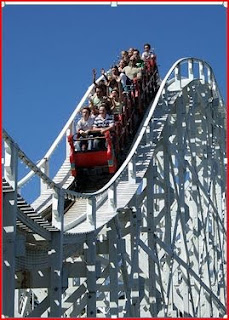
Its no wonder that sometimes levels are a bit like this


(photo wikipedia )
(with thanks to Jopar for reminding me of all the multitude of things we have to get right, every single day and to Tubs for reminding me how I hate that expression!)


.